Make rescheduling hard, and patients just stop showing up.
No AI-generated advice. No generic playbook. I've recouped thousands of dollars by learning this the hard way.
By Oscar Poon · September 29, 2026 · 5 minute read
No AI-generated advice. No generic playbook. I've recouped thousands of dollars by learning this the hard way.
By Oscar Poon · September 29, 2026 · 5 minute read

A reschedule handled in seconds is a patient kept, not lost.
A few real numbers to set the scene before we get into the math:
70%
higher chance a patient won't return within 18 months after missing just one appointment with their provider
Clinekt Health, How to Reduce Patient No-Show Rates: Seven Steps and the Arithmetic Behind Them ↗
65.3%
of scheduling errors and mishaps end with a patient who never comes back
DexCare, Patient No-Show Rates: What the Data Says and What Health Systems Can Do ↗
19%
attrition rate for patients who never miss an appointment, versus nearly 70% for those who miss just one
Curogram, Why Do Patients Miss Appointments? Top 5 Reasons Explained ↗
46%
of providers now let a patient reschedule directly from the reminder message itself
Tebra, Why patients no-show: causes and proven ways to reduce cancellations ↗
Patients who miss a single appointment have close to a 70% chance of never coming back within 18 months, compared to just 19% for patients who never miss one. Whatever caused that miss matters less than what happens right after it.
Scheduling friction, being put on hold, playing phone tag, waiting on a callback, is enough to make a patient give up. They don't reschedule. They just don't show up instead.
65.3% of scheduling errors and hiccups, a mistimed call, a mixed-up date, a request that fell through the cracks, end with a patient who simply never returns.
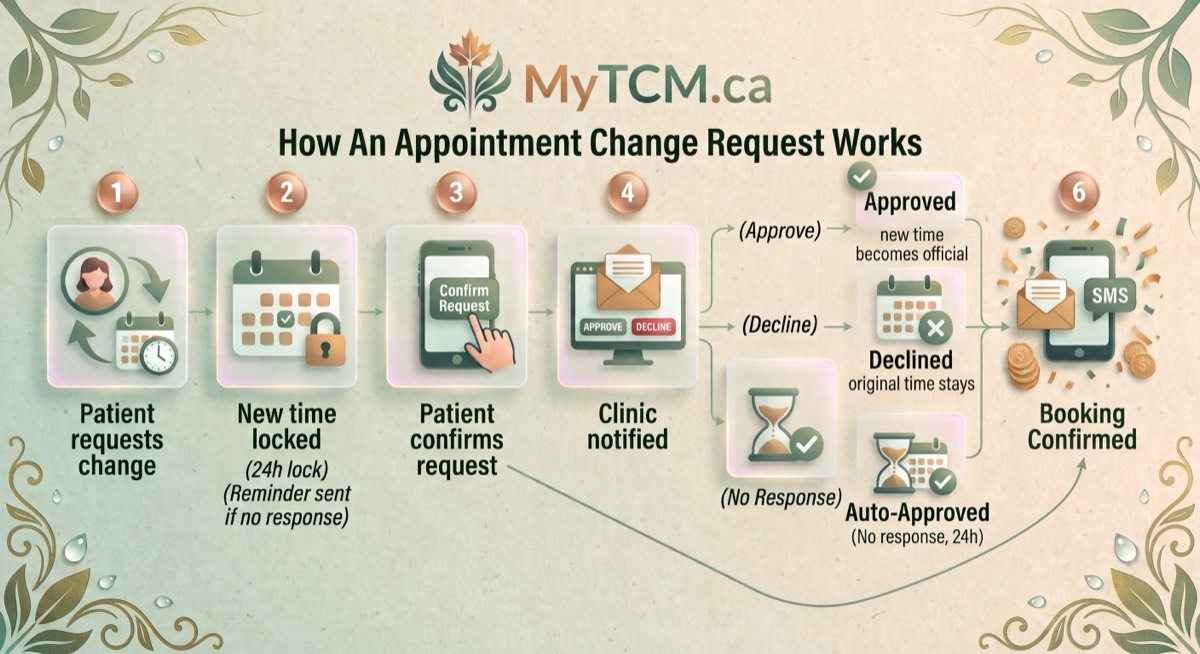
46% of providers already support this because it works: a patient with a real conflict gets a new time in seconds instead of quietly deciding not to bother.
If the clinic doesn't respond in time, a sensible default (auto-approve after 24 hours) means the request doesn't just sit there and die. The patient keeps their new time, and the appointment stays on your books instead of vanishing.
Using an $80 average treatment fee as an example, if self-service rescheduling turns a would-be no-show into a kept visit instead:
A patient with a real conflict shouldn't have to choose between an awkward phone call and just not showing up. Rescheduling themselves, quietly and without an excuse required, keeps them as your patient instead of losing them to embarrassment.
Every reschedule request has a resolution, automatically.

How automatic rescheduling works in MyTCM, start to finish.
The rescheduled appointment stays linked to the same patient record and chart history. No duplicate entries, no lost notes, no starting over.
Self-service rescheduling is part of the same $10-a-month online booking plan, no extra charge. Compare that to what a single lost patient is actually worth.
A $10 fix is cheap insurance against losing a patient for good.
Questions? Call 1-888-884-7726